How to compare custom-product quotes when the scope is not the same
A low unit price can describe a smaller order, a different decoration, an earlier handoff, or costs that have simply been left outside the quote. Compare the completed buying scenario instead.
Start with the buying scenario, not the unit price
For a branded tumbler, tote, or event kit, two quotations can both say "$4.80 each" and still describe different purchases. One may include one-color screen print, the other a digital decoration; one may be priced at 500 units and the other at 1,000; one may end at a factory gate while the other includes freight to a named destination. Neither is necessarily wrong. They are simply not yet comparable.
The useful decision is: which supplier can deliver the same defined project at the lowest acceptable total cost and risk? Write that project definition before requesting revised figures. The U.S. International Trade Administration says a pro forma invoice should identify the quoted items, unit and extended prices, weights and dimensions, delivery point, Incoterm, payment terms, estimated shipping date, and validity date (Trade.gov). Those fields make a good minimum comparison record even when the order stays domestic.
Build one normalization sheet
Use one row per supplier and one common project brief. Do not silently fill a blank field with an optimistic assumption. Mark it "not quoted" and ask the supplier to confirm it.
Comparison field
Set once for every supplier
Why it changes the decision
Product and construction
Exact item, size, material, color, included parts, packaging
Related products
A similar-looking substitute may not have the same customer value or handling needs.
Quantity and over/under rule
Exact order quantity and permitted variance
Tier breaks and production tolerance can alter the extended total.
A price in a different currency or with a shorter validity window is not the same commercial offer.
Cost responsibility
Named Incoterm where relevant, plus explicitly listed exclusions
Price alone does not say who pays freight, insurance, clearance, taxes, or destination handling.
Then calculate a comparison total: quoted goods + decoration + applicable one-time charges + packaging + freight/insurance where quoted + destination or project charges that the buyer will bear. Keep taxes, duties, brokerage, storage, and local delivery in separate columns when they are not confirmed. A blank is an open risk, not a zero.
This is consistent with Trade.gov’s definition of landed cost as the price at the buyer’s doorstep, including product price, insurance, freight, tariffs and taxes, and other fees (Trade.gov). It is a planning definition, not a current-duty calculator. Classification, origin, valuation, destination rules, and the importer of record can change the actual amount. Obtain project-specific customs or broker advice when those items matter.
Make delivery language comparable
Where a cross-border quote uses an Incoterm, copy the term, version, and named place exactly into the sheet—for example, not just "DAP" but the stated named destination. ICC explains that Incoterms® 2020 allocate costs, risk, and obligations, and organizes delivery, transfer of risk, carriage, insurance, clearance, packaging, cost allocation, and notices in separate articles (ICC).
That distinction matters because a named destination can describe where carriage is arranged without necessarily being the point where risk transferred. ICC also warns that changing a cost allocation should be made clear in the contract, including whether the delivery and risk point changes (ICC). Do not label a quote "delivered" unless the actual quotation identifies what delivery includes and excludes.
For a domestic shipment, an Incoterm may not be used. You still need an equivalent plain-language answer: who books and pays freight, what address is included, when the supplier hands goods to the carrier, whether unloading or appointment charges are included, and who absorbs a reroute after proof approval.
Compare timing as a cost condition
A quotation should identify its estimated shipping date and validity date, but those dates do not by themselves prove an in-hands commitment. Ask each supplier to separate: proof turnaround; clock start after artwork/proof approval; production duration; freight transit; and the latest approval date that keeps the requested delivery window. If a quote includes a rush option, request its incremental charge, what it accelerates, and whether inventory is confirmed for the requested variant.
Apply the same treatment to samples. A pre-production sample can be worth more than a lower purchase price when a logo treatment or color match is central to the end customer’s approval. Record its cost, lead time, approval consequence, and whether its result controls production. Do not assume a marketing image, an unbranded sample, and an approved production proof are equivalent evidence.
Decide with a documented exception list
Once every quote has the same scope, rank the comparable total beside delivery confidence and unresolved items. A supplier can remain viable with an unknown field, but its quote should not win purely on a subtotal that excludes that field. The right next step is a targeted clarification, such as: "Please confirm the total for 500 units, one front full-color print, delivered to this ZIP by this date; list all one-time charges and exclusions."
For a reseller, retain the completed sheet with the customer brief and dated quote. It makes later scope changes visible. It does not replace the purchase order, import advice, product-specific compliance review, or signed commercial terms.
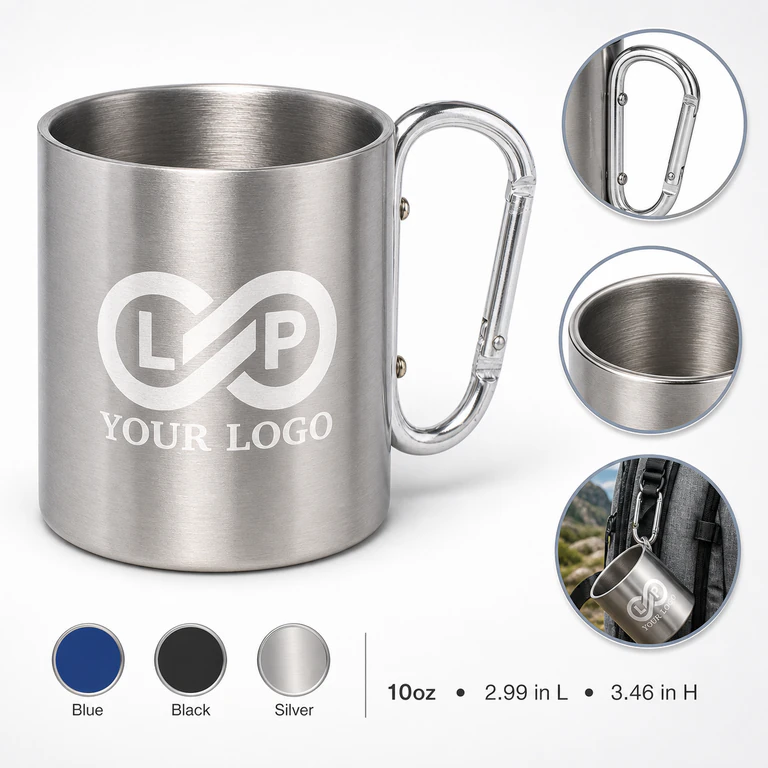
A branded mug is one possible starting point for this planning method. Review the catalogue example LP0207 for the product reference, then confirm the project-specific configuration and commercial terms.