Supplier Due Diligence for Custom Products | LogoPress
Supplier due diligence: separate identity, delivery capability, and sample evidence
A registration document can identify a business. It cannot prove it can meet your artwork, quantity, quality, and delivery date. Treat identity, capability, and sample evidence as separate questions.
Three questions, three kinds of evidence
A custom promotional-product order often starts with a reassuring bundle of materials: a business license, product photos, a catalog, a sample, and a fast reply. They are useful, but they answer different questions. A diligence error is allowing one item to answer all of them.
Keep these questions separate:
Who is the contracting supplier? Confirm the legal entity that will quote, invoice, receive payment, and accept the purchase order.
Can that supplier deliver this project? Test its ability to make the specified item, apply the requested decoration, control quality, and meet the calendar and delivery scenario.
What does this sample or proof actually evidence? Identify whether it proves a product attribute, a decoration result, an approval point, or only a concept.
This separation is practical for small orders as well as large ones. It makes a distributor’s customer-facing promise match the evidence in hand and keeps a visually persuasive sample from being treated as proof of a production system.
Lens one: establish the entity and the commercial counterparty
Ask for the legal name, registered address, business registration or equivalent identifier where available, primary contact, invoice details, payment beneficiary name, and the entity that will sign the order. Compare the information across the quote, invoice, bank instructions, and public registry available for the jurisdiction. A mismatch is a question to resolve before payment, not proof of misconduct.
Related products
Also document the delivery chain: is the quoted party the manufacturer, an agent, a trading company, or a subcontracting coordinator? There is no inherently unsafe answer, but the role changes the evidence you need. If manufacturing is subcontracted, ask who controls artwork release, material specification, production inspection, corrective action, and shipment release.
The seller and buyer identification fields on a pro forma invoice are a useful commercial cross-check (Trade.gov). They cannot establish production capability.
Lens two: test capability against this order
Replace the broad question "Are you capable?" with a project-specific request. Supply the product specification, quantity, decoration locations and method, artwork state, packaging, ship-to destination, required in-hands date, and any product documentation the end customer needs. Then request concrete responses: current availability for the exact variant; production lead time measured from what approval event; decoration specification; quality checkpoints; packing dimensions and weights; and the person responsible for resolving a nonconformance.
Evidence needed
Stronger project-specific evidence
What it does not prove
Identity
Matching legal/invoice/payment details and a verifiable registration where available
Capacity, quality, or an exact delivery date
Production capability
Specification-linked process description, current material/variant confirmation, production plan
That an unrelated catalog item can be produced the same way
Quality control
Acceptance criteria, inspection point, defect handling, dated records for the relevant process
A universal defect-free outcome
Delivery capability
Named handoff point, dated production window, packing data, freight plan, approval deadline
A guaranteed arrival if inputs or carrier conditions change
Past performance
Relevant, permissioned references or records that can be checked
Automatic success on a different material, decoration, or quantity
A NIST MEP manufacturing blog article suggests asking for quality-system documentation, production and inspection information, capacity context, and logistics information (NIST MEP). It is a manufacturing-practice article, not a standard; use its questions as prompts and scale evidence to project risk.
Lens three: label the sample or proof precisely
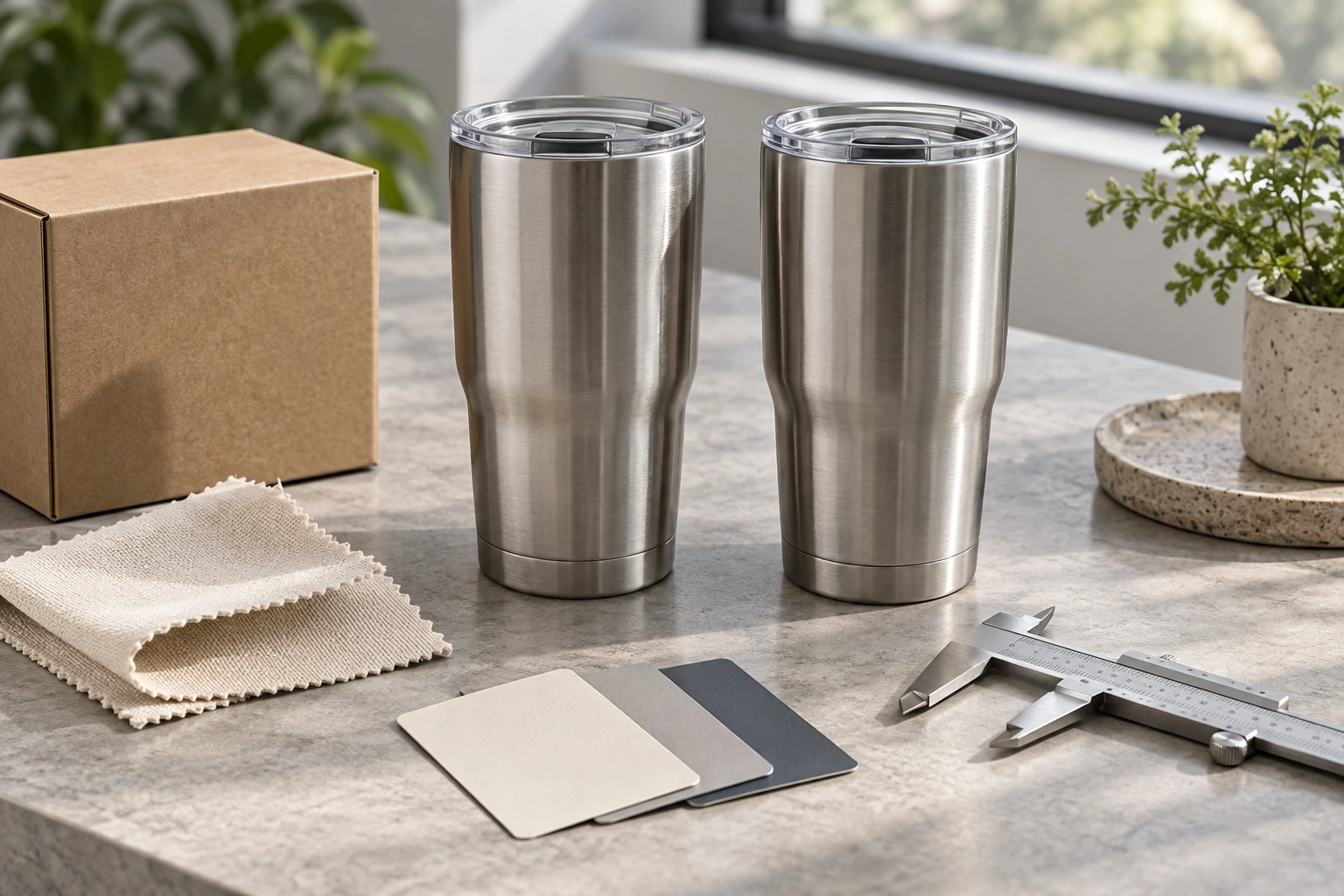
A sample is evidence only for what it matches. An unbranded stock sample may show hand feel, base construction, and approximate color; it does not prove logo placement, decoration durability, current stock, final packaging, or lead time. A digital proof may confirm layout and relative placement; it does not prove the physical color, print opacity, or finished product. A pre-production sample can provide stronger evidence when it uses the final material, decoration method, artwork, packaging, and acceptance criteria, but it still does not erase the need to control approved changes before production.
Record the sample’s status in the order file: date; source; specification matched; photos or measurements; observed result; approval or rejection; and the exact production version it authorizes. If a change is made after approval—material, location, color count, factory, packaging, or shipment plan—ask whether the sample evidence still applies.
NIST’s 2026 due-diligence quick-start guide defines due diligence as researching available pertinent information for informed acquisition decisions and names provenance, resilience, and supply-chain tiers among its assessment components (NIST SP 1326). Its stated scope is ICT suppliers. Use it here only as a disciplined way to ask where evidence came from and which party or tier it covers; it is not a certification scheme for promotional products.
Set a proportionate release gate
Before issuing a purchase order, create a short release record with three columns: confirmed, open, and owner/date. Confirm the counterparty, final specification, approved artwork/proof, price and exclusions, production-start trigger, delivery responsibility, and any required project documentation. Escalate unresolved issues when their likely consequence exceeds the project’s margin, deadline slack, or brand tolerance.
For a routine replenishment from a proven source, the record can be brief. For a new supplier, a rush deadline, a new decoration method, or a product that needs specific compliance documentation, strengthen it with a sample or independent verification appropriate to the risk. The process does not prove that a supplier will perform flawlessly, and it does not replace legal, customs, safety, or product-compliance advice. It does give the buyer a clear answer to a more useful question: what is verified for this order, by whom, and what remains an assumption?
A custom bag is one possible starting point for this planning method. Review the catalogue example LP0251 for the product reference, then confirm the project-specific configuration and commercial terms.